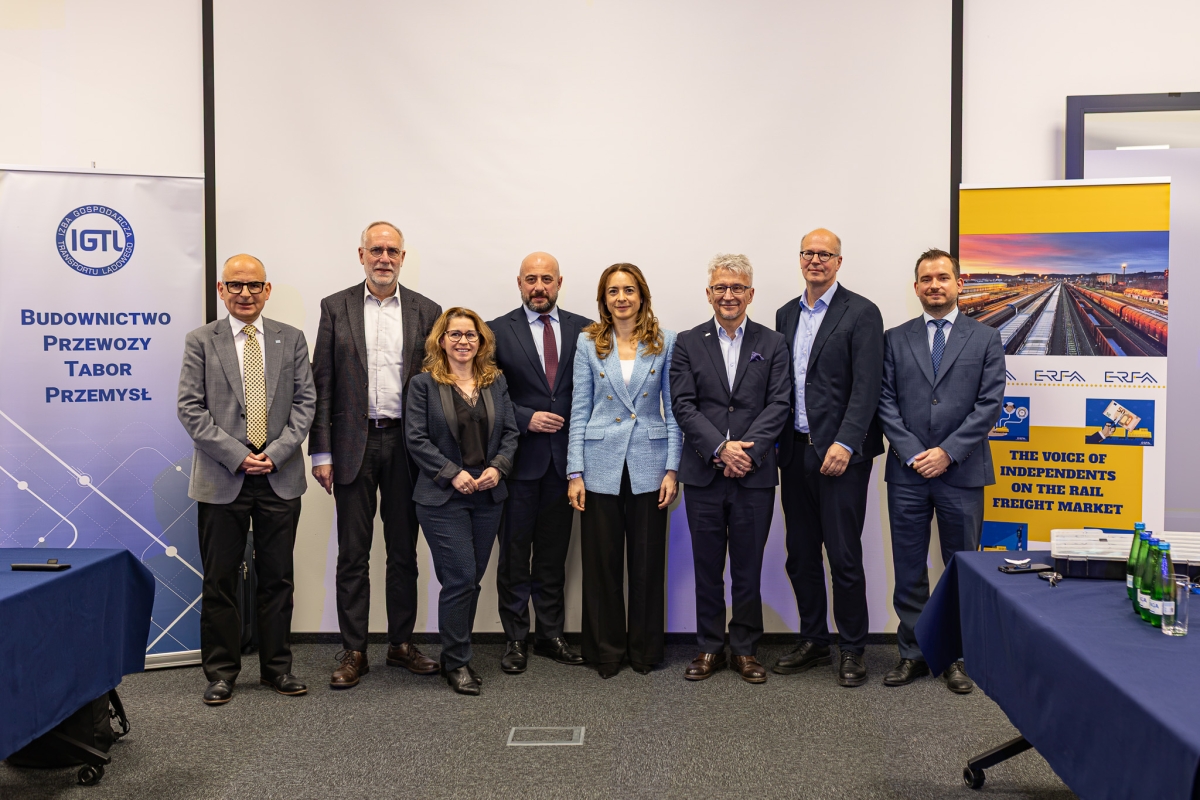
There is much to gain from the revision of the Train Drivers Directive (TDD): more flexibility for railway undertakings and easier mobility for train drivers across borders and companies, while maintaining high standard of safety during operations. This was the shared message from stakeholders across the Sector and industry at the Train Drivers Seminar co-organised by the European Rail Freight Association (ERFA), the Polish Land Transport Chamber of Commerce (IGTL), and the Polish Office of Rail Transport (UTK) in Warsaw.
Ahead of European Commission’s proposal to revise the TDD, the seminar brought together representatives of railway undertakings, train drivers unions, and national safety authorities. The event took place at UTK’s Train Driver Examination and Monitoring Centre in Warsaw.
Participants held a round table discussion with Oana Gherghinescu, Executive Director of the European Union Agency for Railways (ERA), Joachim Lücking, Head of Unit – Rail Safety and Interoperability at the European Commission, Ignacy Góra, President of the Polish Office of Rail Transport (UTK), and Diego Martín Fernández, President of the Federation of European Train Drivers’ Unions (ALE).
More than half of European freight trains cross at least one EU internal border, so reducing fragmented rules and unnecessary requirements is urgent. Even though the original TDD brought some progress since its adoption in 2007, significant issues persist and must be tackled now.
Ignacy Góra, President of the Office of Rail Transport (UTK), emphasised that true mobility and mutual recognition across the EU depend on high, uniform examination standards and digitalisation: "Mutual recognition of train driver qualifications works only when every examination across Europe is equally reliable and demanding. Based on Poland's experience at the Train Driver Examination and Monitoring Centre (CEMM), separating training from independent examination and integrating full-cab simulators into examination rules significantly strengthens operational safety. Addressing driver shortages requires faster, digital procedures and an interconnected EU-wide register verifiable in real time—never lowering examination standards."
Pawel Wiechoczek, Director Service Design at DB Cargo Polska and IGTL expert highlighted that language barriers for train drivers remain a major obstacle for international rail transport. Alongside local language and supported by digital tools, English should become one of the communication languages along designated European transport corridors. He also underlined that mutual recognition of qualifications and tests, modular train driver certificates, and digitalisation of trainings as priorities.
Götz Walther, Head of Railway Operations at the Association of German Transport Companies (VDV), outlined that route knowledge requirements still rest on principle of the steam era and should reflect the evolution of the EU railway system. For instance, digital route book provided by infrastructure managers, given the completeness and accuracy of data, can facilitate the access to route knowledge a train driver must acquire in advance. This would further support operations during degraded and emergency times when train drivers may take alternative route from which they have no prior knowledge.
The roundtable discussion identified a set of conditions for a successful revision of the TDD:
1) Safety first: the revision must maintain, and where possible improve, today's level of safety.
2) Portable competence: European mutual recognition of qualifications and examinations, supported by modular certificates, so drivers do not repeat what they have already proven.
3) Practical communication across borders: language rules that combine national languages, railway terminology and validated digital tools on international corridors.
4) Modern-day route knowledge: risk-based requirements that take account of today's signalling, training and real-time information from infrastructure managers.
5) Less bureaucracy, no new costs: digital certification and training, with simpler procedures for operators and authorities.
6) Clear on principles, flexible on details: the revision must specify core elements while details will remain adaptable to take into account rapid evolutions in the field of digitalisation.
ERFA, IGTL and UTK will continue to work closely with the European institutions, Member States and sector partners to lay the foundations for a relaunch of rail freight. An ambitious revision of the TDD has an important role to play in that effort.
About ERFA
The European Rail Freight Association represents private and independent rail freight companies and advocates for fair competition and non-discriminatory market access within the European rail sector.
About IGTL
The Land Transport Chamber of Commerce (Izba Gospodarcza Transportu L?dowego – IGTL) is a Polish association representing companies related to rail transport and infrastructure investments towards the Polish and EU administration.
About UTK
The Office of Rail Transport (Urz?d Transportu Kolejowego – UTK) is Poland's independent rail market regulator and national safety authority. UTK supervises railway safety, technical interoperability, passenger rights, and non-discriminatory access to rail infrastructure, while also issuing train driver licences, maintaining the National Register of Train Drivers, and conducting independent state examinations at its Train Driver Examination and Monitoring Centre (CEMM) in Warsaw.
Picture: © UTK